

1. What is AI in SEO? (Simple Explanation for Beginners)
Artificial Intelligence (AI) in SEO means using smart tools and algorithms to improve your website’s visibility on search engines like Google. In simple terms, AI helps you understand what users are searching for, create better content, and optimize your website faster and more accurately.
AI analyzes huge amounts of data such as search behavior, keywords, and user intent. Instead of guessing what works, AI gives data-driven suggestions. For example, AI tools can recommend the best keywords, suggest content topics, and even predict which content will rank higher.
For beginners, think of AI as your SEO assistant. It helps you do keyword research, optimize blog posts, and improve rankings without needing deep technical knowledge. This is why many businesses in Ahmedabad and beyond are adopting AI SEO strategies.
A practical example: If you are writing a blog about “real estate marketing,” AI tools can suggest related keywords like “digital marketing for property leads” or “online real estate advertising tips.”
If you want to learn more about optimizing structured data, you can explore “learn more about schema markup strategies.”
2. How AI is Changing SEO in 2026
AI is transforming SEO by making search engines smarter and more user-focused. In 2026, SEO is no longer just about keywords—it’s about understanding user intent and delivering real value.
Search engines now use AI models to analyze content quality, relevance, and user satisfaction. This means websites with helpful, well-structured, and user-focused content rank higher. AI also powers features like Google’s AI Overview, voice search, and personalized results.
One major change is predictive SEO. AI tools can now forecast trends and help you create content before competitors. This gives businesses in Ahmedabad a strong advantage in local and niche markets.
Another big shift is automation. Tasks like keyword research, content optimization, and technical SEO can now be done faster using AI tools. However, human creativity is still important for storytelling and trust-building.
Example: AI can suggest blog topics based on trending searches, but humans add real-life insights and expertise to make content engaging.
3. Why AI Matters More Than Ever for SEO Success
AI matters in SEO because competition is increasing, and search engines are getting smarter. Without AI, it becomes difficult to keep up with changes in algorithms and user behavior.
AI helps improve efficiency. Instead of spending hours on manual research, you can use AI tools to get insights in minutes. This allows businesses to focus more on strategy and content quality.
Another reason is accuracy. AI tools analyze real-time data, helping you make better decisions. For example, AI can identify which keywords have high potential and low competition.
AI also improves user experience. It helps create personalized content, faster websites, and better search results—all of which are ranking factors.
For small businesses in Ahmedabad, AI SEO strategies provide a cost-effective way to compete with larger brands.
4. Top AI Tools You Should Use for SEO in 2026
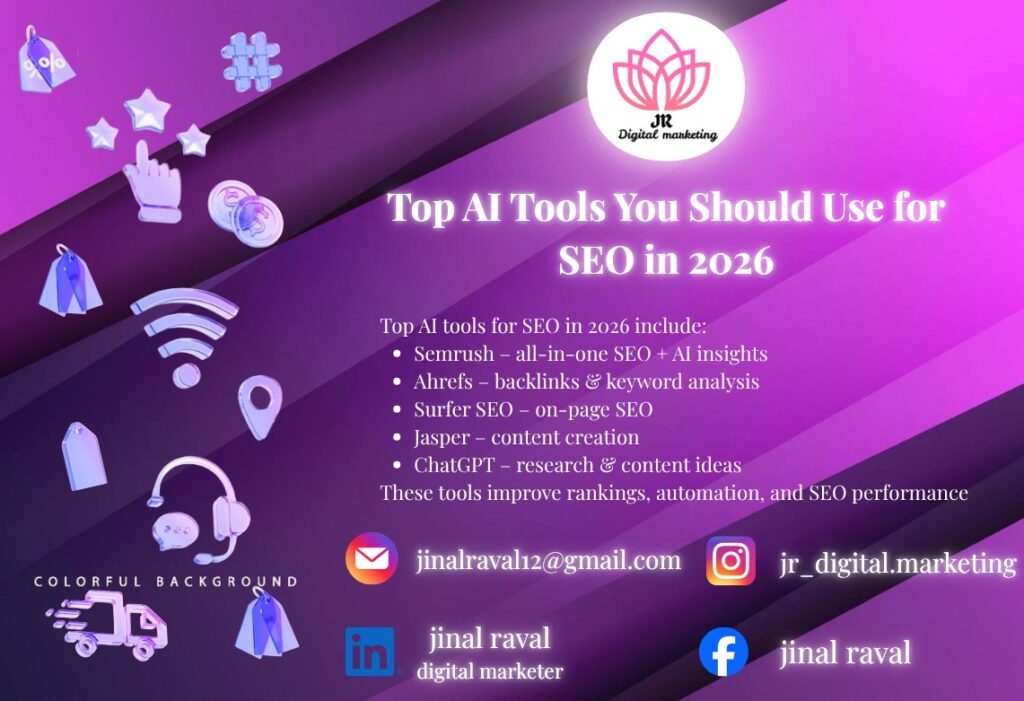
Using the right tools is essential for success. Here are some of the best AI tools for SEO optimization in 2026:
| Tool Name | Best For | Key Feature |
|---|---|---|
| ChatGPT | Content creation | AI writing & idea generation |
| Surfer SEO | On-page SEO | Content optimization score |
| SEMrush | Keyword research | Competitive analysis |
| Jasper AI | Content writing | Blog & copy generation |
| Frase | Content briefs | AI-driven outlines |
These tools help with keyword research, content creation, and performance tracking. For example, you can use AI to generate blog outlines and then refine them manually for better quality.
Pro tip: Combine multiple tools for better results instead of relying on just one.
5. How to Do Keyword Research Using AI
AI-based keyword research techniques make it easier to find high-ranking keywords. Instead of guessing, AI tools analyze search trends and suggest relevant keywords.
Start by entering a primary keyword like “AI SEO strategies.” The tool will generate related keywords, long-tail variations, and search intent data.
Focus on long-tail keywords such as “how to use AI for SEO in 2026” because they have less competition and higher conversion rates.
AI also helps identify user intent—whether users want information, services, or products. This allows you to create content that matches their needs.
Example: For a business in Ahmedabad, targeting “AI SEO strategies for small businesses 2026” can attract local customers.
You can also “learn more about keyword clustering techniques” to group similar keywords and improve rankings.
6. AI Content Writing vs Human Writing: What Works Best?
AI content writing is fast, scalable, and data-driven, while human writing adds creativity, emotion, and trust. The best approach is a combination of both.
AI can generate blog drafts, suggest headings, and optimize content for SEO. However, it may lack originality and real-world experience. Human writers bring storytelling, expertise, and authenticity.
Comparison:
| Factor | AI Writing | Human Writing |
|---|---|---|
| Speed | Very fast | Slower |
| Creativity | Limited | High |
| Accuracy | Data-based | Experience-based |
| SEO Optimization | Strong | Needs tools |
Best practice: Use AI for research and drafting, then refine the content manually.
7. How Google Uses AI to Rank Websites
Google uses AI systems like RankBrain and machine learning models to understand content and rank websites. These systems analyze user behavior, content relevance, and quality.
AI looks at factors such as:
- Content usefulness
- User engagement
- Page experience
- Search intent match
Websites that provide clear, helpful, and well-structured content rank higher. This means keyword stuffing no longer works.
Example: A blog that answers user questions clearly and provides value will perform better than one filled with keywords.
8. AI and Voice Search Optimization in 2026
Voice search is growing rapidly, and AI plays a major role in it. People now use conversational queries like “What is the best AI SEO strategy for beginners?”
To optimize for voice search SEO optimization with AI:
- Use natural language
- Answer questions directly
- Focus on long-tail keywords
- Optimize for local search
For example, a business in Ahmedabad should target queries like “best SEO services near me.”
Voice search requires content that is simple, direct, and easy to understand.
9. How to Optimize Content for AI Search Engines
AI search engines like ChatGPT and Gemini prefer structured and clear content. To optimize:
- Use headings and subheadings
- Write short, clear paragraphs
- Answer questions directly
- Add examples and use cases
Start each section with a clear answer to improve chances of appearing in featured snippets.
Also, include semantic keywords and related terms naturally. This helps AI understand your content better.
10. Common Mistakes to Avoid in AI SEO
Many beginners make mistakes when using AI for SEO. Common errors include:
- Over-relying on AI-generated content
- Ignoring user intent
- Keyword stuffing
- Not editing AI content
- Using outdated strategies
AI should assist, not replace human expertise. Always review and improve AI-generated content.
11. Future Trends of AI in SEO You Must Know
The future of SEO with artificial intelligence includes:
- More personalized search results
- Increased use of voice and visual search
- AI-generated search summaries
- Predictive content strategies
Businesses that adapt early will gain a competitive advantage.
.
12. Step-by-Step Guide to Start AI SEO Today
Here is a simple beginner guide to AI SEO strategies:
- Choose the right AI tools
- Do keyword research using AI
- Create optimized content
- Improve on-page SEO
- Track performance and adjust
Start small and gradually improve your strategy. Consistency is key to ranking higher on Google.
A: AI and SEO in 2026 work together to improve search performance. AI helps in keyword research, content creation, and user intent analysis. Search engines also use AI to rank content better. Businesses using AI tools can create smarter strategies, improve visibility, and reach the right audience faster.
A:AI helps small businesses save time and improve SEO results. It can suggest keywords, optimize content, and analyze competitors. AI tools also track performance and give insights for better decisions. This allows small businesses to compete with larger brands without needing a big marketing team.
A:AI is changing SEO by focusing more on user intent and content quality. Search engines now understand natural language better. AI tools automate tasks like keyword research and content optimization. This makes SEO faster, smarter, and more focused on delivering useful information to users.
A:Start by choosing AI tools for keyword research and content ideas. Next, use AI to create and optimize content. Then, analyze performance using AI insights. Finally, update content regularly based on data. This step-by-step approach helps content creators improve rankings and save time..
A:Popular AI tools include Surfer SEO, Frase, Clearscope, and Jasper. These tools help optimize content with keyword suggestions, readability improvements, and SEO scoring, making it easier to rank higher on search engines.
A:Top AI keyword research tools include SEMrush, Ahrefs, Ubersuggest, and Keyword Insights. These tools provide search volume, keyword difficulty, and content ideas, helping you choose the best keywords for better SEO results.
A:Small businesses can use AI-powered platforms like Rank Math, SEMrush, Alli AI, and Outranking. These platforms automate SEO tasks, provide insights, and improve website performance without needing advanced technical skills.
A:Companies like Shopify, BigCommerce, SEMrush, and BrightEdge offer AI-powered SEO solutions. These platforms help ecommerce sites optimize product pages, improve rankings, and increase sales through better search visibility.
Author : jinal y. raval
[digital marketer]
Student of : ASDM